Please note: We are closed on Thursday, Oct 29 for our annual Gala celebration. Plan your visit …
Please note: We are closed on Thursday, Oct 29 for our annual Gala celebration. Plan your visit …
Please note: We are closed on Thursday, Oct 29 for our annual Gala celebration. Plan your visit …
All News
Apr 20, 2026
Asian Art Museum presents first North American survey of the acclaimed Korean artist
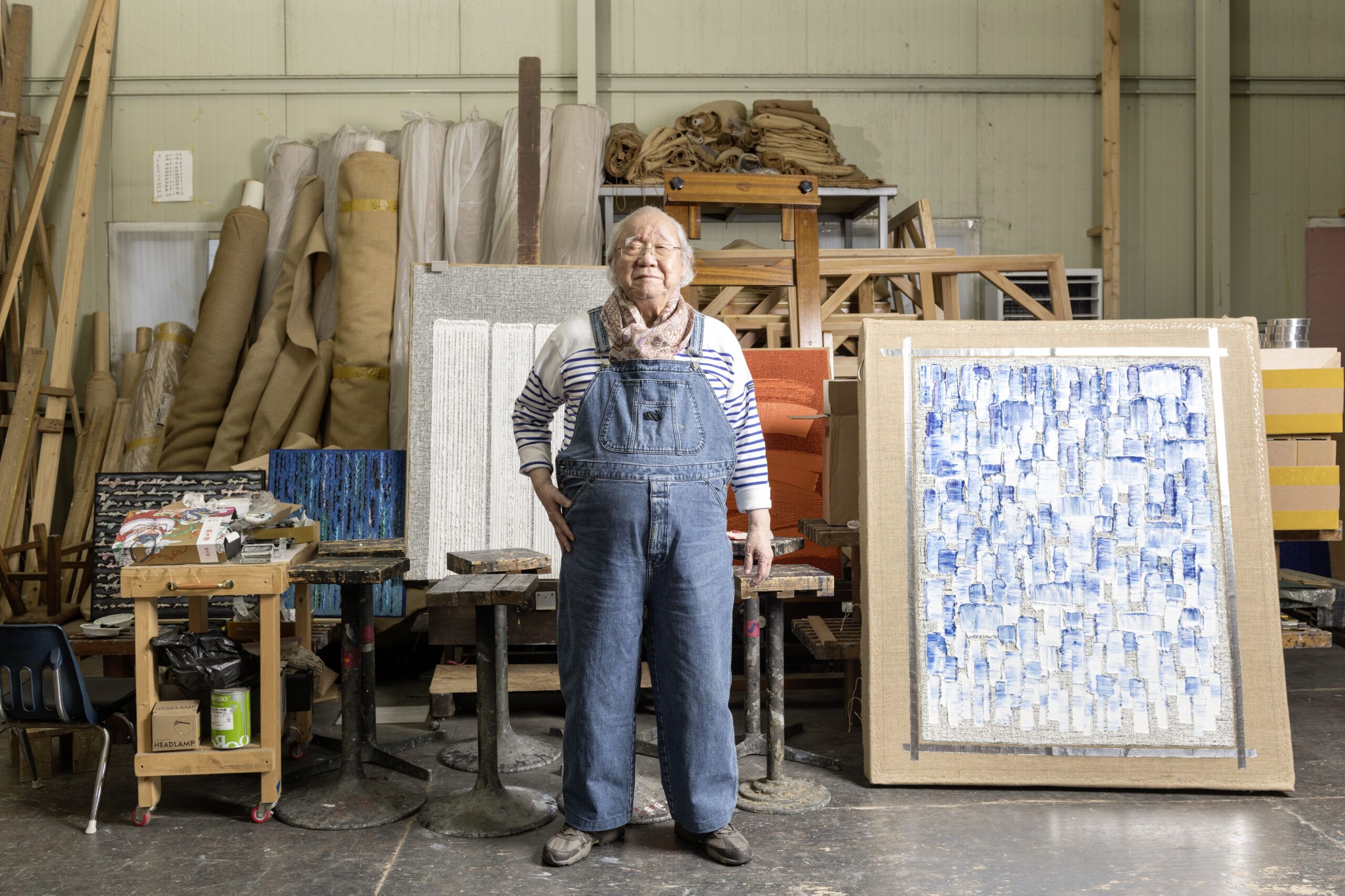
San Francisco, APRIL 20, 2026 — Ha Chong-Hyun: Retrospective, on view September 25, 2026–January 25, 2027, at the Asian Art Museum, is the first major North American museum exhibition by pioneering Korean contemporary artist Ha Chong-Hyun. The exhibition features more than 50 paintings — including two new works completed as recently as 2025 — tracing Ha’s creative evolution over more than six decades.
Ha Chong-Hyun: Retrospective is guest curated by eminent Seoul-based scholar and curator Sunjung Kim. Currently the Artistic Director of Art Sonje Center in Seoul and the chair of ICOM (International Council of Museums) Republic of Korea, Kim served as President of the Gwangju Biennale Foundation (2017–2021) and commissioner of the Korean Pavilion at the 51st Venice Biennale.
Born in 1935 during Japanese colonial rule and coming of age in the aftermath of the Korean War, Ha developed his practice in a country marked by upheaval, scarcity, and rapid transformation. These conditions are embedded in the structure and materials of his work — as in his frequent use of industrial burlap sacks, once used to ship rice to South Korea after the war, as canvases.
Works from the early 1960s introduce an artist beginning to test the limits of conventional painting, as Ha rejects composition in favor of physical exploration: thick paint layered onto canvas, bundles of thread embedded into surfaces, and passages scorched by flame. As Korea underwent rapid industrialization, Ha’s visual language shifted. Works from the White Paper on Urban Planning series translate the expanding infrastructure of cities into bold grids and radiating lines. A founding member of the Korean Avant-Garde Association (AG) in 1969, Ha entered a charged environment shaped by political repression and artistic experimentation; the stacks of censored newspapers and blank pages in Counter-Phase (1971) quietly register the constraints of the period.
Ha’s breakthrough arrived with the Conjunction series, begun in 1974. Here, Ha developed his signature “back-pressure” method: applying thick oil paint to the reverse of his burlap canvas until it breaks through the fabric’s coarse weave to the front, carrying with it the marks of pressure, resistance, and time.
“For Ha, painting is not about illusion or representation,” said exhibition curator Kim. “It is about encounter — between the artist’s body and the material, between pressure and release. That encounter is what gives the work its enduring power.”
While many of Ha’s works share the restrained palettes and serial mark-making of his contemporaries in the early 1970s Dansaekhwa (monochrome painting) movement, his output is set apart by its physical intensity.
As the Conjunction series unfolds, surfaces become modular and spatial, engaging light, movement, and perception. Painting here is inseparable from construction — cutting, wrapping, and assembling — opening new possibilities for how a painting occupies space. In the 2010s, Ha began incorporating vivid primary colors, expanding beyond the restrained palette of Dansaekhwa toward a more contemporary language. In Ha’s most recent works, charred materials and ash merge with paint in compositions animated by assertive colors.
“Ha Chong-Hyun’s work reshapes how we understand abstraction — as a visceral experience, more than a purely visual language,” said Soyoung Lee, The Barbara Bass Bakar Director and CEO of the Asian Art Museum. “This exhibition reveals an artist who expanded the possibilities of painting and embodied the realities of his time and place.”
The retrospective also places Ha within a broader global context. Working in parallel with figures such as Donald Judd and Agnes Martin, he shares an interest in repetition and materiality, but his work diverges in its embrace of visible labor and imperfection. Where Western Minimalism often sought industrial precision, Ha’s surfaces retain vulnerability — each mark a trace of effort and resistance.
Seen in full, Ha Chong-Hyun: Retrospective unfolds as a sustained inquiry into what painting can be when pushed — physically and conceptually — beyond its limits. It is also a reminder that the story of postwar abstraction is neither singular nor Western, but global.
A leading institution presenting Asian and Asian diaspora artists, the Asian Art Museum is a fitting venue for this retrospective. With San Francisco celebrating the 50th anniversary of its sister city relationship with Seoul this year, this exhibition contributes to amplifying the impact of Korean art and culture in the Bay Area and globally.
About Ha Chong-Hyun
Ha Chong-Hyun has lived and worked in Seoul since graduating from Hongik University in 1959. Awarded an honorary doctorate degree from the institution, he served as Dean of the Fine Arts College at Hongik University (1990–1994) and later served as Director of the Seoul Museum of Art (2003–2006). His work has appeared in major Biennale exhibitions worldwide and at the Hammer Museum, Los Angeles; the National Museum of Contemporary Art, Gwacheon; the Denver Art Museum; the Song Art Museum, Beijing; the Solomon R. Guggenheim Museum and Brooklyn Museum, New York; the Erarta Museum, St. Petersburg; the Art Institute of Chicago; and the Fondazione Mudima, Milan. His works are included in the permanent collections of the Guggenheim; the Art Institute of Chicago; M+, Hong Kong; the Tokyo Metropolitan Art Museum; the Museum of Contemporary Art, Hiroshima; and the Leeum, Samsung Museum of Art and the National Museum of Modern and Contemporary Art, Seoul.
Exhibition Organization
Ha Chong-Hyun: Retrospective is organized by the Asian Art Museum and guest curator Sunjung Kim, Artistic Director of Art Sonje Center, with assistance from Art Sonje Center’s curatorial team.
Presenting sponsorship is provided by SK∙PODO Museum.
Generous support is provided by Tina Kim Gallery and Kukje Gallery.
Major support is provided by Canal Projects and the Kahng Foundation.
Additional support is provided by Esther and Thomas “Tom” Lee.
Sustained support generously provided by the Akiko Yamazaki and Jerry Yang Endowment Fund for Exhibitions and the Kao/Williams Contemporary Art Exhibitions Fund.
About the Asian Art Museum
Located in the heart of San Francisco, the museum is home to one of the world’s finest collections of Asian and Asian American art, with more than 20,000 awe-inspiring works ranging from ancient jades and ceramics to contemporary video installations. Dynamic special exhibitions, cultural celebrations, and public programs for all ages provide rich art experiences that unlock the past and spark questions about the future.
###
Image: Ha Chong-Hyun in his studio. Photo by Chunho An.