All News
Jul 2, 2026
Asian Art Museum presents Vishnu’s Cosmic Ocean, a once-in-a-lifetime encounter with the largest ancient bronze ever discovered in Cambodia — and a story of water, power, and creation that still resonates today.
San Francisco, JULY 2, 2026 —
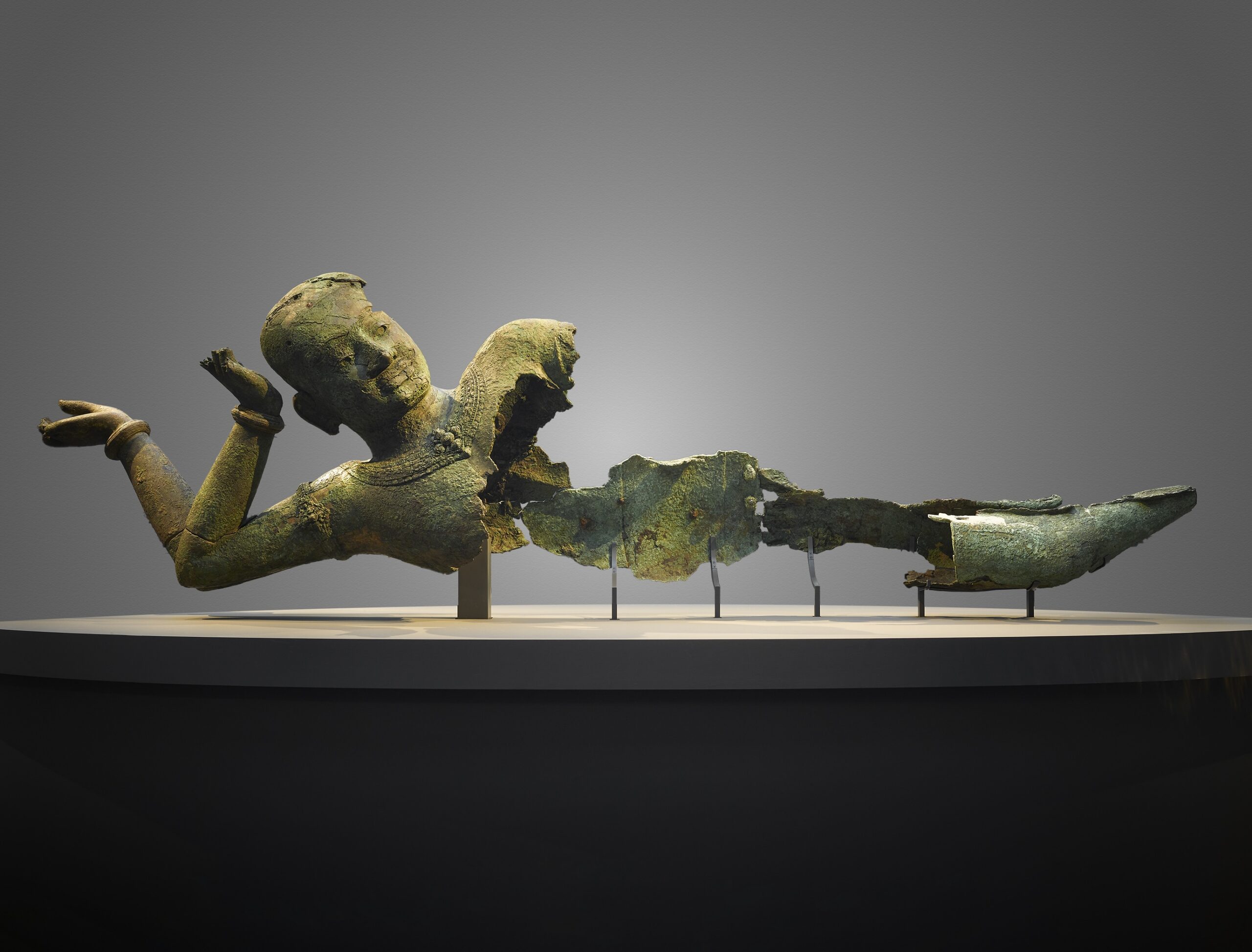
Nearly one thousand years ago, a colossal bronze image of the Hindu god Vishnu rested on a man-made island in the middle of a vast reservoir in the Khmer kingdom of Angkor in present-day Cambodia. Reclining atop a cosmic serpent and floating on the primordial waters, the sculpture embodied both divine power and the prosperity of one of the world’s great civilizations.
Then it disappeared.
Buried for centuries and rediscovered only in 1936, the monumental sculpture — now recognized as the largest ancient bronze ever found in Southeast Asia — will be the centerpiece of the special exhibition Vishnu’s Cosmic Ocean, on view at the Asian Art Museum from October 23, 2026, through January 25, 2027. Presented in the museum’s Osher Foundation Gallery, the exhibition marks the final stop on an international tour and offers visitors a rare opportunity to experience a Cambodian national treasure that is unlikely to travel again.
On loan from the National Museum of Cambodia, the recently restored masterpiece anchors the Asian Art Museum’s first special exhibition devoted exclusively to Cambodian art. This opportunity supports the museum’s commitment to working with the Kingdom of Cambodia to promote and protect its rich cultural heritage.
“Few works of art can tell a story this large,” said Soyoung Lee, The Barbara Bass Bakar Director and CEO of the Asian Art Museum. “This extraordinary sculpture invites us to consider how art, religion, engineering, and the natural world came together to shape one of history’s greatest civilizations. It also reflects a truth that feels especially relevant today: water remains one of humanity’s most powerful and precious resources. This exhibition exemplifies our belief that Asia’s stories are global stories.”
At nearly twenty feet in length when complete, the bronze Vishnu originally occupied the West Mebon, an eleventh-century temple constructed on an island in the center of the West Baray, a reservoir measuring roughly five miles long and more than a mile wide. The placement was no accident. In Hindu cosmology, Vishnu reclines on a cosmic ocean during the intervals between cycles of creation, preserving the universe within himself until a new world emerges.
The exhibition reveals how rulers of Angkor adapted these religious ideas to reinforce their authority and connect sacred narratives to the kingdom’s remarkable hydraulic infrastructure. Canals, reservoirs, moats, and embankments allowed Angkor to manage seasonal water flows, sustain agricultural abundance, and support one of the largest urban centers of the medieval world.
“Visitors may arrive expecting to see a masterwork of ancient sculpture,” said Natasha Reichle, the museum’s associate curator of Southeast Asian art, and curator of the exhibition. “What they discover is a much bigger story — one about the relationship between water and power, the ingenuity of Angkor’s engineers, and the ways societies use art to express their deepest ideas about creation, kingship, and the natural world. The Vishnu is both a work of extraordinary beauty and a gateway into understanding Cambodia’s remarkable history.”
The exhibition traces the sculpture’s journey from its likely creation in an Angkorian royal foundry to its rediscovery after a villager reportedly dreamed of an image buried beneath the temple. Visitors will learn about recent conservation and scientific research that revealed new insights into the work’s manufacture, including evidence that the sculpture was originally gilded and required an astonishing quantity of molten bronze to produce.
Alongside the Vishnu, interpretive displays, maps, and videos explore the kingdom of Angkor, the mythology surrounding Vishnu’s cosmic ocean, and the central role water played in shaping Cambodian society. The exhibition also highlights Angkor’s enduring significance as a UNESCO World Heritage Site and a source of cultural identity and pride for Cambodians today.
The presentation arrives during the annual Cambodian Water Festival season, creating opportunities for community partnerships and public programs that connect ancient traditions to contemporary life.
More than an exhibition about a single object, Vishnu’s Cosmic Ocean offers a rare encounter with a sculpture that stands at the intersection of art, belief, environment, and human ingenuity. It is a story rooted in Cambodia, yet one that speaks to universal questions about how civilizations flourish, how people understand their place in the world, and how the resources that sustain us continue to shape our collective future.
Exhibition Organization
The presentation of Vishnu’s Cosmic Ocean is made possible with lead support from Lyna Lam, A Khmer Buddhist Foundation.
Generous support is provided by The Bernard Osher Foundation and the Society for Asian Art.
Sustained support generously provided by the Akiko Yamazaki and Jerry Yang Endowment Fund for Exhibitions.
This exhibition is organized by the Asian Art Museum of San Francisco and the Smithsonian’s National Museum of Asian Art in collaboration with the Guimet-National Museum of Asian Arts, France, with exceptional loans from the National Museum of Cambodia granted by the Royal Government.
The conservation of the Reclining Vishnu of West Mebon was made possible thanks to the financial support of the International Alliance for the Protection of Heritage—ALIPH—and to the scientific collaboration of the Ecole Française d’Extrême Orient (EFEO), the Centre de Recherche et de Restauration des Musées de France (C2RMF), and the Guimet-National Museum of Asian Arts, France.
About the Asian Art Museum
Located in the heart of San Francisco, the museum is home to one of the world’s finest collections of Asian and Asian American art, with more than 20,000 awe-inspiring works ranging from ancient jades and ceramics to contemporary video installations. Dynamic special exhibitions, cultural celebrations, and public programs for all ages provide rich art experiences that unlock the past and spark questions about the future.
###
Image: West Mebon Reclining Vishnu, National Museum of Cambodia, Phnom Penh, Cambodia; © Mario Ciampi