All News
Aug 28, 2026
Balinese paintings and sculptures bring the epic adventures of Garuda, Indonesia’s divine bird-warrior, to life.
San Francisco, AUGUST 28, 2026 — A bird with the body of a man, the wings of an eagle and the power to defeat the gods, Garuda is one of the most recognizable figures in Indonesian culture. His adventures have been told and retold through painting, sculpture, dance and shadow puppetry, with each storyteller bringing a distinctive emphasis to the divine bird’s exploits. Garuda in Bali, at the Asian Art Museum, invites visitors into that world through remarkable paintings and sculptures created in Bali around the turn of the 20th century.
On view September 18, 2026, through January 4, 2027, the exhibition centers on one of Garuda’s most celebrated adventures: his quest to rescue his mother, Winata, from enslavement. After she loses a rigged bet to her sister, Kadru, Winata is forced into servitude. Her freedom comes with an almost impossible price: Garuda must steal the elixir of immortality, guarded by the gods in heaven, and deliver it to Kadru’s serpent sons. Determined to free his mother, Garuda sets off on a quest that pits him against supernatural forces at every turn.
In Garuda battles the gods and steals the elixir of immortality, a traditional Balinese painting from approximately 1910–1930, Garuda appears repeatedly across the composition, allowing viewers to follow his journey through multiple scenes. He battles the gods, approaches the cave where the elixir is kept and ultimately makes off with the sacred potion. The painting is not a single frozen moment but a visual narrative unfolding across time.
Another work, Garuda, Wibawasu, Supratika, is filled with frenzied energy. Garuda has captured an elephant and turtle to eat, following his father’s advice to gain the strength he needs. The animals were once feuding brothers, transformed by a curse. Yet the painting also contains mysterious figures and scenes whose meanings remain uncertain, suggesting how fluid storytelling could be in Balinese art.
“Garuda’s story can be seen as a story about what we will do for the people we love,” says Natasha Reichle, associate curator of Southeast Asian Art at the Asian Art Museum. “His courage is extraordinary, but his devotion to his mother adds a twist to the typical hero’s journey.”
Storytelling is central to the exhibition. Balinese paintings often repeat characters several times within a single composition, inviting viewers to follow the action from one scene to the next. These narratives were also familiar through dance and wayang kulit, or shadow puppetry. The paintings were part of a larger, living storytelling tradition rather than illustrations of fixed texts.
The exhibition also evokes the original ritual context of these works. Paintings on cloth were traditionally displayed in temples and royal settings for only a few days each year, surrounded by textiles, decorations and offerings as a form of homage to the gods.
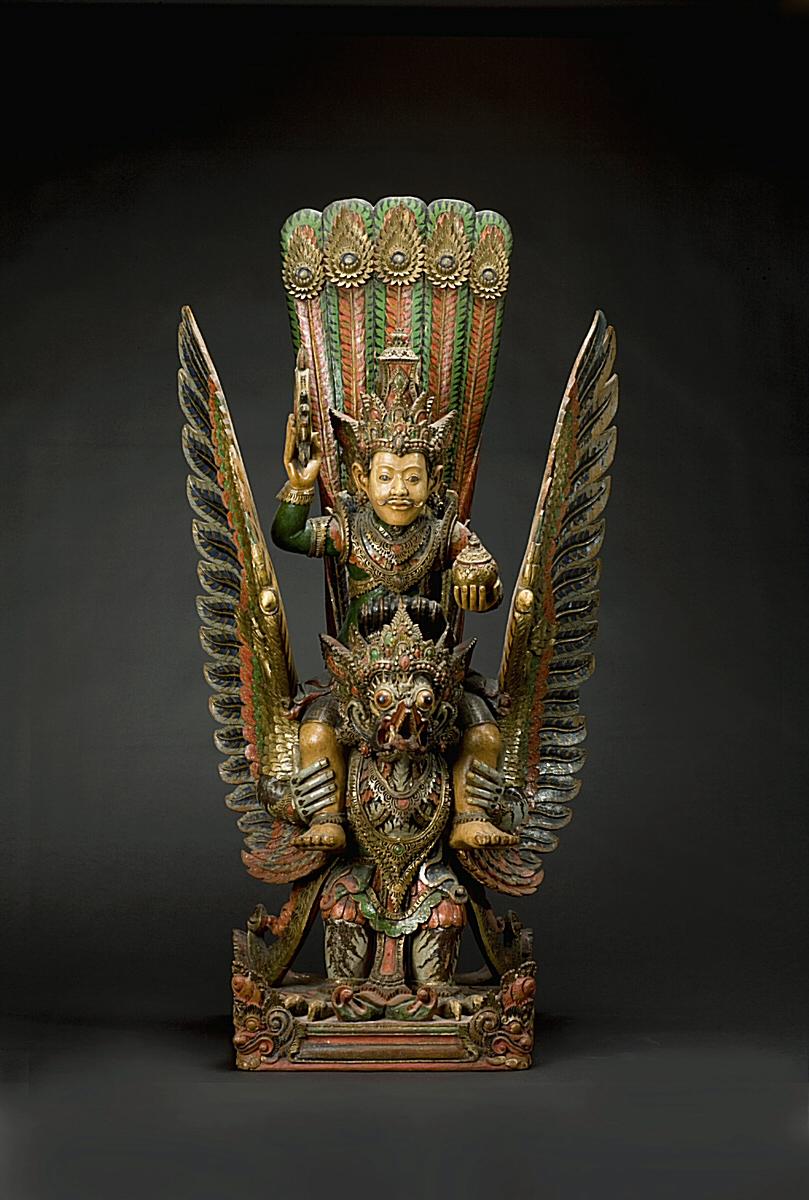
That spirit continues in the gallery itself, where hand-drawn graphics inspired by Balinese artists including Ketut Madra and Ni Made Suciarmi surround the artworks. At the center is The Hindu deity Vishnu riding Garuda, a monumental wooden sculpture in which Garuda’s towering wings frame the god he serves. Nearby, The demon king Ravana riding the mythical bird Wilmana offers a reminder that not every powerful bird in Balinese art is Garuda.
Though Garuda’s stories originated in Indian traditions, Balinese artists gave them their own emphasis and flavor. Across Indonesia, his courage, loyalty and power helped make him an enduring national emblem.
Garuda in Bali is organized by the Asian Art Museum.
Sustained support generously provided by the Akiko Yamazaki and Jerry Yang Endowment Fund for Exhibitions and the Kao/Williams Contemporary Art Exhibitions Fund.
About the Asian Art Museum
Located in the heart of San Francisco, the museum is home to one of the world’s finest collections of Asian and Asian American art, with more than 20,000 awe-inspiring works ranging from ancient jades and ceramics to contemporary video installations. Dynamic special exhibitions, cultural celebrations, and public programs for all ages provide rich art experiences that unlock the past and spark questions about the future.
Image: The Hindu deity Vishnu riding Garuda, approx. 1840-1920. Indonesia- North Bali. Colors and gold on wood. Asian Art Museum, Acquisition made possible by the Connoisseurs’ Council and the estate of K. Hart Smith, 2010.18.1. Photograph © Asian Art Museum